

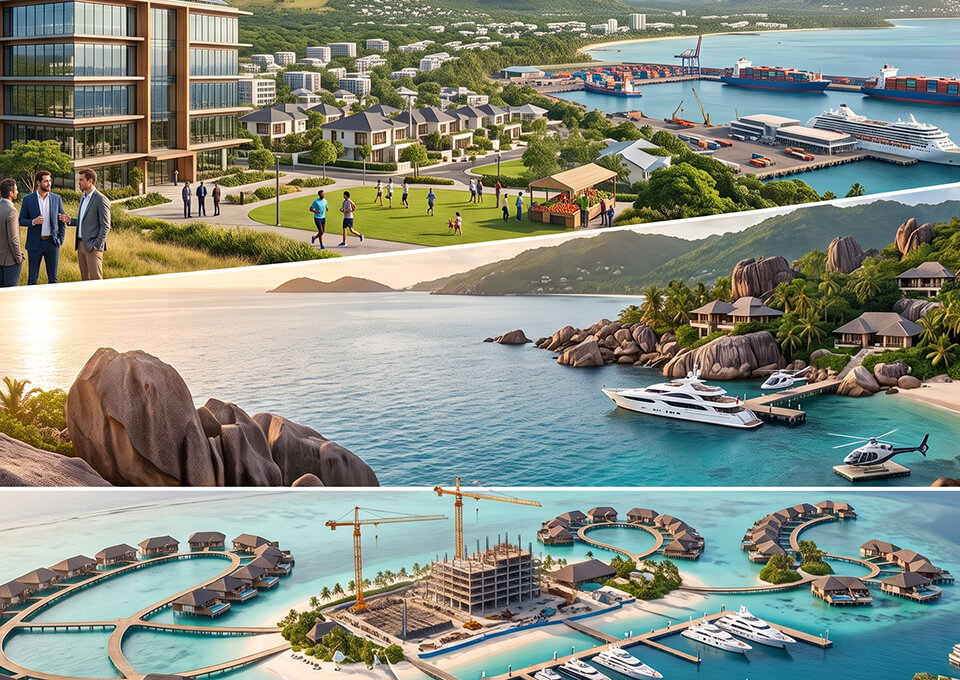
The Indian Ocean luxury real estate market in 2026 is defined by competition between three primary destinations that have each established distinctive positions in the international investment and lifestyle buyer market: Mauritius, Seychelles, and the Maldives. Each offers a compelling combination of natural beauty, high-quality tourism infrastructure, and aspirational lifestyle attributes. Each has regulatory frameworks designed to attract international property investment. And each is actively competing for the limited pool of high-net-worth international capital that seeks Indian Ocean real estate exposure.
Understanding how these three markets compare across the dimensions that matter most for serious long-term real estate investment, institutional quality, investment framework sophistication, market liquidity, economic stability, and the structural drivers of long-term demand, is essential context for investors making allocation decisions in the region. The Apavou Group, with its four-decade presence in the Mauritius real estate market under the leadership of founder Armand Apavou, and its portfolio spanning major developments including Plaisance Mall, Terre d’Été, and The Cube, observes this competitive dynamic from the perspective of deep long-term market engagement.
Mauritius, the institutional leader
Mauritius enters 2026 as the most institutionally sophisticated and most comprehensively developed real estate investment market of the three destinations. The island’s advantages in this competitive set are multiple and mutually reinforcing. The regulatory framework for foreign real estate investment, built over two decades through the progressive development and refinement of the IRS, PDS, Smart City, and related investment schemes, is the most transparent, most comprehensive, and most internationally credible of the three markets. International buyers can acquire freehold property through clearly defined legal pathways, with regulatory certainty and legal protection that is comparable to developed market standards.
The institutional quality of Mauritius, its independent judiciary, its well-maintained property register, its stable democratic governance, and its sophisticated professional services infrastructure, provides the foundation of investor confidence that long-term capital requires. The island’s track record of honouring investment commitments across multiple global economic cycles, including the severe test of the Covid-19 pandemic, has demonstrated the durability of these institutional foundations in a way that words and presentations cannot substitute for.
Mauritius market depth and liquidity
Mauritius also leads the three markets in terms of secondary market depth and liquidity for completed premium residential properties. The island has an established track record of IRS and PDS resales stretching back to the mid-2000s, providing buyers with real evidence of market pricing, transaction timelines, and the availability of buyers for completed properties. This secondary market depth is important for investors who need the confidence that their Mauritius investment can eventually be realised rather than remaining permanently illiquid.
The depth of the Mauritius premium residential market is reinforced by the diversity of the buyer base, European, South African, Indian, Chinese, and other Asian buyers, combined with a growing regional African buyer demographic, which provides multiple independent sources of demand. In the Seychelles and Maldives, the international buyer pool tends to be narrower and more concentrated, making secondary market liquidity more dependent on the health of a smaller number of buyer categories.
The commercial and mixed-use advantage
Mauritius’s competitive advantage extends beyond the premium residential market that most direct comparisons with Seychelles and the Maldives focus on. The island’s commercial real estate market, supported by the Ebene business district, the financial services sector, and growing technology and professional services activity, provides a dimension of investment diversification that neither Seychelles nor the Maldives can offer. For investors seeking balanced Indian Ocean exposure across residential and commercial categories, Mauritius is uniquely positioned, as demonstrated by the Apavou Group’s diversified portfolio across Plaisance Mall, The Cube, and Terre d’Été.
Seychelles, premium environment, evolving framework
Seychelles offers some genuinely extraordinary natural attributes, an archipelago of uniquely beautiful islands with exceptional biodiversity, near-pristine marine environments, and a luxury tourism brand that is among the most exclusive in the world. The Vallee de Mai and the Aldabra Atoll are UNESCO World Heritage Sites, and the country’s commitment to conservation has preserved environmental qualities that are genuinely irreplaceable. These natural attributes create a compelling foundation for ultra-luxury real estate investment in a segment where the physical environment is the primary value driver.
The Seychelles regulatory framework for foreign real estate investment has developed significantly in recent years, with clearer pathways for international buyers to acquire property and improved legal certainty around ownership structures. The country has also made meaningful progress in economic stabilisation and governance improvement following the severe 2008-2009 crisis that exposed the vulnerabilities of an earlier less diversified economic model. These improvements have supported renewed international investor interest in the Seychelles market.
Seychelles limitations, concentration and liquidity risk
Despite the improvements of recent years, Seychelles continues to carry several structural limitations as an investment destination relative to Mauritius. The economy remains highly concentrated in tourism, creating sensitivity to global travel disruptions that the Mauritius economy, with its more diversified base in financial services, technology, and manufacturing, handles with greater resilience. Property market liquidity in Seychelles is limited: the island archipelago’s small size, limited development land, and narrow buyer pool mean that secondary market transactions are infrequent and that achieving competitive pricing for resales can require patience that exceeds what many investors anticipate.
The professional services infrastructure that supports real estate investment, legal, financial, and advisory services at the level of sophistication that international institutional investors require is less developed in Seychelles than in Mauritius, creating higher transaction costs and greater uncertainty for buyers who lack deep local connections. For serious long-term investors comparing the two markets, these structural differences argue for a meaningful premium in expected returns from Seychelles to compensate for its lower institutional quality and more limited liquidity.
Maldives, the world’s finest island experience, with specific investment constraints
The Maldives represents a fundamentally different investment proposition from Mauritius and Seychelles. The country’s extraordinary natural environment, the purest atoll system in the world, with exceptional marine biodiversity and near-perfect beach conditions, has supported the development of the world’s most exclusive luxury resort industry, with internationally recognised brands including One & Only, Four Seasons, Aman, and many others operating in the archipelago. Luxury resort accommodation in the Maldives commands among the highest room rates in the world, reflecting both the exceptional natural environment and the strong demand from ultra-high-net-worth visitors globally.
However, the Maldives imposes fundamental constraints on foreign real estate ownership that significantly limit the investment framework available to international property buyers. Foreign freehold ownership of land in the Maldives is not generally available, the constitutional framework reserves land ownership for Maldivian nationals. International investors can access the Maldives market primarily through leasehold structures, through investment in resort operating companies, or through specific government-designated development zones where long-term leasehold arrangements approximate effective ownership for investment purposes. These structural constraints make the Maldives a fundamentally different investment vehicle from Mauritius freehold acquisition.
Climate risk, the Maldives’ existential challenge
The Maldives faces a long-term challenge that is unique in its severity among the three destinations being compared: climate change-driven sea level rise. The country’s average elevation above sea level is approximately 1.5 metres, making it among the most vulnerable nations in the world to sea level rise projections under various climate scenarios. While the Maldives government is investing significantly in coastal protection and land reclamation, and while the timeline for serious disruption may extend beyond most investment holding periods, the existential vulnerability of the country’s physical environment to climate change creates a long-term risk dimension that is not present for Mauritius or Seychelles at equivalent severity.
For long-term real estate investors, whose investment horizons may extend to twenty, thirty, or more years, this climate vulnerability is a material consideration in Maldives investment risk assessment, particularly for coastal assets. The increasing frequency of extreme weather events and the sustained pressure of sea level rise will create growing insurance, maintenance, and asset protection costs for Maldives real estate that will erode returns progressively over time and create increasing uncertainty about long-term asset values.
Capital flows in 2026, where the evidence points
Across the three markets, capital flow evidence in 2026 reflects the structural advantages and limitations described above. Mauritius continues to attract the largest and most diversified flow of international real estate capital, driven by the breadth of its investment framework, the depth of its secondary market, the diversity of its buyer base, and the commercial real estate dimension that the other markets do not offer. The pipeline of new IRS and PDS scheme development in Mauritius, the activity of established development groups like the Apavou Group, and the continued strong international buyer demand for quality Mauritius residential product all reflect the market’s continued attractiveness to serious long-term capital.
Seychelles is attracting growing interest from ultra-high-net-worth buyers who value its extreme exclusivity and pristine environment above the greater market sophistication of Mauritius, a buyer demographic that is less price-sensitive and less liquidity-focused than the broader premium buyer market. This ultra-premium positioning supports strong capital flows in the top tier of the Seychelles market even as the overall market remains narrower and less liquid than Mauritius.
The Mauritius structural advantage for long-term investment
For investors with genuine long-term investment horizons, who are evaluating Indian Ocean real estate as a multi-decade wealth preservation and generation strategy rather than a short-term lifestyle acquisition, the structural advantages of the Mauritius market become increasingly compelling relative to the alternatives. The depth and diversity of the Mauritius investment framework, the quality of its institutional foundations, the breadth of its buyer base, and the commercial real estate dimension that provides portfolio diversification opportunities all contribute to a risk-adjusted return profile that outperforms the alternatives for long-term, quality-focused capital.
Mauritius maintains its regional leadership
In the competitive Indian Ocean real estate investment market of 2026, Mauritius maintains its position as the regional leader for serious long-term investment capital, not because the other destinations lack genuine appeal, but because the combination of institutional quality, investment framework sophistication, market depth, economic diversification, and commercial real estate opportunity that Mauritius offers is simply not replicated elsewhere in the region. For investors in developments like those of the Apavou Group, Plaisance Mall, Terre d’Été, and The Cube, the Mauritius market provides the most reliable foundation for long-term investment performance available in the Indian Ocean region.
 Previous Post
 Next Post