

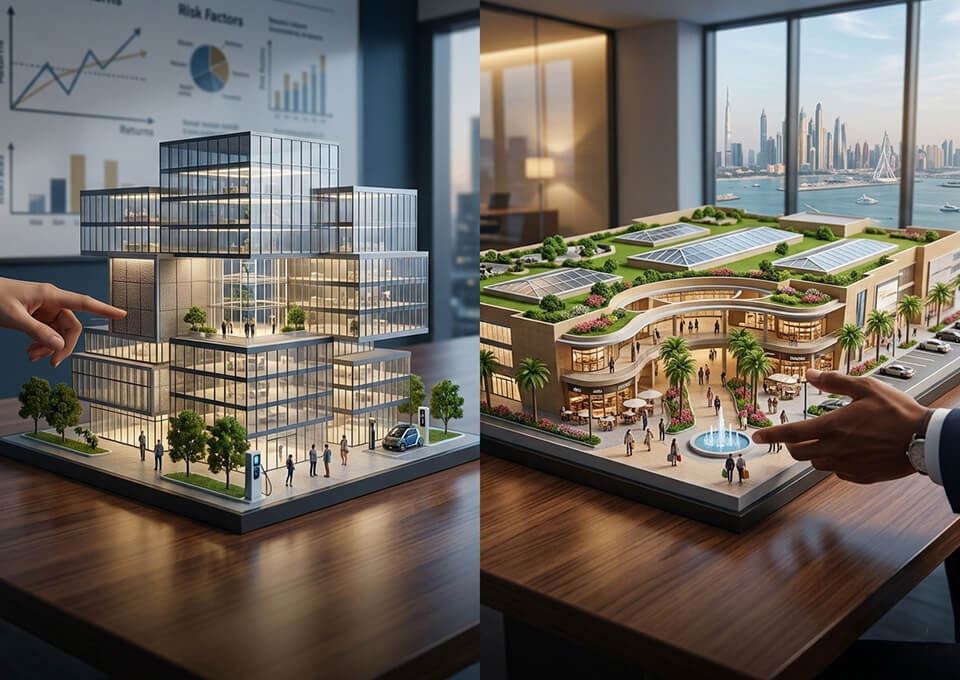
Investment analysis benefits enormously from concrete case studies, real, observable projects whose actual performance and structural characteristics can be examined directly, rather than relying purely on theoretical models or generic market assumptions. The Cube and Plaisance Mall, two substantial Apavou Group developments with meaningfully different structural characteristics, together offer a useful comparative case study for investors seeking to understand how different asset types perform within the Mauritian market.
Because both developments sit within the same corporate group and the same broader Mauritian market context, this comparison offers a genuinely controlled setting for isolating how asset-type-specific structural differences, rather than differences in developer quality, market access, or geography, shape investment risk and return characteristics.
Why comparing within a single group produces cleaner insight
Comparing two projects from entirely different developers introduces confounding variables that make it difficult to isolate exactly which differences in performance stem from the underlying asset type versus differences in the developers’ respective execution quality, market access, or capital resources. Comparing The Cube and Plaisance Mall, both developed by the same group under broadly similar organisational capabilities and market conditions, allows for a cleaner isolation of how the underlying asset type itself, rather than developer-specific factors, shapes investment characteristics, making this comparison a genuinely more rigorous analytical exercise than a cross-developer comparison would typically allow.
Two distinct investment profiles within a single portfolio
Plaisance Mall and The Cube represent genuinely distinct investment profiles, despite both falling under the broader Apavou Group umbrella. Plaisance Mall, as a more conventional single-use retail development, carries a more straightforward risk and return profile, driven primarily by retail-specific demand factors, consumer spending, tourism footfall, and competitive dynamics within the local retail sector. The Cube, as a mixed-use development combining office, retail, and service functions, carries a more complex, blended risk profile that depends on the performance of multiple, only partially correlated demand drivers simultaneously.
For an investor evaluating these two projects as comparative case studies, this structural difference alone offers a valuable lesson: within the same broader market and even under the same corporate umbrella, meaningfully different investment risk profiles can coexist, meaning that generic statements about “Mauritius real estate risk” understate the genuine variation in risk and return characteristics across different specific asset types and structures.
Comparing revenue stability and predictability
Plaisance Mall’s revenue model, built around conventional retail leasing to a diversified tenant base, offers a reasonably predictable revenue stream once the asset reaches stabilised occupancy, subject primarily to lease renewal cycles and broader retail sector performance trends. The Cube’s revenue model, blending office and retail leasing, introduces additional complexity, office leasing cycles typically differ from retail leasing cycles in duration and renewal patterns, meaning The Cube’s overall revenue stability depends on how well these different leasing cycles are staggered and managed, a more complex revenue management undertaking than a single-use asset like Plaisance Mall requires.
This comparison illustrates a broader principle relevant to evaluating any mixed-use investment: the blended nature of mixed-use revenue can provide genuine diversification benefits, but only if the different revenue streams are managed with sufficient sophistication to avoid the added complexity undermining the diversification benefit it’s meant to provide. An investor evaluating The Cube specifically should weigh not just the theoretical diversification benefit of its blended revenue model, but the demonstrated quality of the management team responsible for actually realizing that benefit in practice.
Capital intensity and development risk comparison
The Cube’s mixed-use format likely required more capital-intensive, and correspondingly higher-risk, development execution than Plaisance Mall’s more conventional retail format, given the additional coordination complexity of building multiple functionally distinct components within a single structure. This higher development-phase risk needs to be weighed against The Cube’s potentially higher long-term value proposition, the internal diversification and land-efficiency benefits that a well-executed mixed-use format can provide relative to a single-use development on comparable land.
For investors, this trade-off between higher development-phase risk and potentially superior long-term structural characteristics represents a genuine, non-trivial investment decision, rather than a straightforward case where one format is unambiguously superior to the other across every relevant dimension. Investors with a lower risk tolerance or a shorter investment horizon might reasonably prefer Plaisance Mall’s more straightforward risk profile, while investors with a longer horizon and greater risk tolerance might find The Cube’s higher development-phase risk an acceptable trade-off for its potentially superior long-term structural resilience.
Exit and liquidity comparison
Plaisance Mall, as a large but single, unified retail asset, likely offers more limited exit optionality than a more granular or divisible investment might provide; monetisation would typically require either an outright sale of the entire asset or a more complex partial ownership restructuring. The Cube’s mixed-use structure, depending on its specific legal and ownership structuring, might offer somewhat greater flexibility, potentially allowing different functional components to be monetised separately if structured to permit this kind of partial disposal, though this flexibility depends heavily on the specific legal and financing structure underlying the development, rather than being an automatic feature of mixed-use developments generally.
Investors evaluating either asset should treat exit optionality as a genuine, explicit input into their return expectations, since the illiquidity premium associated with limited exit flexibility should, in principle, be reflected in a higher required return relative to a comparably risky but more liquid alternative investment.
Tourism sensitivity comparison
Plaisance Mall’s retail-driven revenue model likely carries somewhat greater direct sensitivity to Mauritius’s tourism sector performance than The Cube’s more office-weighted revenue mix, given retail’s closer connection to consumer and visitor spending patterns compared to office demand, which responds more directly to broader business investment and employment trends. This differential tourism sensitivity represents a further useful comparative data point for investors seeking to understand how different Mauritian real estate asset types respond differently to the island’s particular tourism-dependent economic structure.
For an investor specifically seeking to reduce overall tourism-sector exposure within a broader Mauritius-focused portfolio, this comparison suggests that The Cube’s more office-weighted revenue mix might offer a somewhat more defensive positioning during a tourism downturn than a purely retail-focused asset like Plaisance Mall, all else being equal, though both remain meaningfully connected to Mauritius’s broader economic health in ways that a purely domestically-driven asset in a larger, more diversified economy would not be.
What this comparison teaches about portfolio construction
Taken together, comparing The Cube and Plaisance Mall as investment case studies reinforces a broader lesson relevant to constructing any Mauritius-focused real estate investment portfolio: meaningful diversification benefits are available even within a single developer’s portfolio, provided that developer maintains genuinely differentiated asset types rather than a series of superficially different but fundamentally similar projects. Investors seeking genuine risk diversification within their Mauritius real estate exposure should look for this kind of genuine structural differentiation, rather than assuming that exposure to multiple projects automatically provides meaningful diversification if those projects share fundamentally similar underlying risk drivers.
Management complexity as a further point of comparison
Beyond the purely financial dimensions already discussed, Plaisance Mall and The Cube also differ meaningfully in their ongoing management complexity. Plaisance Mall’s single-function retail structure allows for a relatively focused property management approach centred on retail tenant relationships and shopper experience, while The Cube’s blended tenant base requires a management team capable of serving genuinely different tenant needs and expectations simultaneously. This management complexity differential has direct investment implications, since it affects the ongoing operating cost structure and the specific management expertise required to sustain each asset’s performance over time, factors that a purely financial comparison of headline returns might otherwise overlook.
Applying this comparative framework to future investment decisions
The specific comparison between The Cube and Plaisance Mall offers a template that investors can apply more broadly when evaluating other Mauritian real estate opportunities, asking not simply whether a project sits within an attractive market, but specifically how its revenue stability, capital intensity, exit optionality, and tourism sensitivity compare against other opportunities under consideration. Applying this more granular comparative framework consistently, rather than relying on broad market-level assumptions, produces better-informed investment decisions meaningfully across a Mauritius-focused portfolio.
Conclusion
The Cube and Plaisance Mall, examined side by side as investment case studies, illustrate the genuine structural diversity available within the Mauritian real estate market, even among developments from the same established group. Differences in revenue stability, capital intensity, exit optionality, and tourism sensitivity together demonstrate that meaningful investment analysis requires looking well beyond generic “Mauritius real estate” categorisation toward the specific structural characteristics of individual asset types, a level of analytical granularity that ultimately serves investors considerably better than broad, undifferentiated market-level assumptions.
As Mauritius’s real estate sector continues to diversify into an increasingly broad range of formats and structures, this kind of granular, asset-type-specific comparative analysis is likely to become an increasingly essential tool for investors seeking to construct genuinely well-diversified, risk-appropriate exposure to the Mauritian market.
 Previous Post